How Yoga Can Evolve Your Jiu-Jitsu Game

Written by Lydia Lacey

Yoga is an ancient Indian practice, referring to a range of physical, mental and spiritual disciplines designed to aid a person’s self-evolution. It is a complex and broad practice; so what exactly can yoga offer to Brazilian jiu-jitsu practitioners? From the offset, they are two disciplines many lay people wouldn’t picture together, one practice is associated with fighting, the other with inner peace and stillness.

Believe it or not, but as a practitioners of both disciplines, I can tell you that yoga and BJJ fit together like a glove, with yoga complimenting jiu-jitsu fighters better than any other supplement practice. So how exactly can yoga aid your jiu-jitsu?

Rectifying Common BJJ Misalignments

In jiu-jitsu, quite often your body is in a hunch over position, whether you’re in guard or in mount. This puts an excessive strain on the shoulder and neck area, and is doubly destructive if you’re in a seated position at a desk for the larger part of the day. This’ll create bad posture and eventually a weaker spine – your BJJ practice will be significantly limited once your spine becomes restricted in its range of motion. In addition, the hip flexors muscles also tend to become tight and inflexible due to repetitive contractions in many defence positions. As your spine and hips form the basis of your entire physical existence, it is vital you keep such areas mobile for your BJJ practice – your performance is guaranteed to suffer otherwise.

Fortunately there are a series of yoga poses that can rectify the negative effects BJJ can have on the body. For instance, locust and bow pose are beneficial to our posture by strengthening the very core muscle connected to the spine (the multifidis), along with all the outer muscles across the back. As for the hips, lizard pose, warrior 1 and pigeon pose can facilitate in bringing greater mobility to the hips, which is ideal for those that fight off their back and for anyone looking to improve their escaping techniques.

Breath & Mind Control

The whole ethos behind yogi breathing techniques is that you can control your state of mind through the flow of your breath. So imagine those moments before a competition or fight, when your anxiety is running wild – think how useful it would have been to understand how to breathe yourself into a composed, yet alert state of mind. Rather than let adrenaline make you erratic and impulsive, learning to breathe effectively brings about self-control, power and composure, to which you can effectively channel and evolve your nervous energy into a fierce opposition. Yoga teaches you to embrace the present moment with a calm and rational mind – the ultimate form of power.

Being able to breathe effectively is all the more important during competitions – think of how many practitioners gas too quickly in their fights, and it’s no wonder why. Fighters succumb to this rapid, frantic breath that is short, sharp and rapid. Such breathing doesn’t allow the fighter to supply the body and the brain with the necessary oxygen required to continue fighting to its full potential.

Through the practice of yoga, BJJ practitioners can cultivate focus, the ability the manage their emotions and breath effectively during fights.
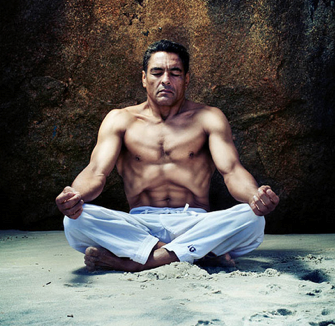
gracie-meditate

Improved Balance & Power

All balancing poses serve to develop core strength and stability, which in turn makes the practitioner stronger. A fighter with strong core is significantly less likely to suffer from injuries and will have more power in their takedowns. Fighters with strong core and balance will be considerably harder to sweep or overthrow from mount, side guard, and so on. A strong sense of equilibrium and the ability to transition swiftly from one position to another are characteristics of a superior jiu-jitsu fighter.

Yoga also cultivates muscular endurance by holding asanas (poses), thus strengthening the muscles to withstand longer rounds with a greater degree of power, which is of course paramount for any serious jiu-jitsu practitioner.By training the body to hold yoga poses, the body will be more able to withstand and blast through a vigorous bout, without injuring itself. Because yoga trains and frees the body to a heightened degree of strength and mobility, the body will be able to endure more and fight with a greater level of freedom.

EnhanceYourBJJGameYoga.jpg

Increased Flexibility & Mobility

My greatest asset as a jiu-jitsu practitioner was by far, my flexibility and mobility. As a petite female, I didn’t have the build or weight behind me to physically overpower my opponents. I had to rely on technique, and utilise the strengths I did have, such as being agile and light. Being heavy certainly does have its advantages in jiu-jitsu, but even the strongest fighter will be severely limited in their progression if their flexibility and mobility remain poor. Escaping positions, transitioning from poses and pulling off more complicated attacks are all the more accessible for practitioners that have a greater range of motion in the joints, which is why the best fighters are well rounded in their fitness.

Practicing yoga regularly would bring greater dexterity to all the necessary muscles and joints. By having greater flexibility, you significantly reduce your chances of incurring many injuries as the range of motion within both the muscles and joints have increased. Being flexible enables the practitioner to execute more complicated submissions as well as escapes, giving the fighter more options in their game.
bjj

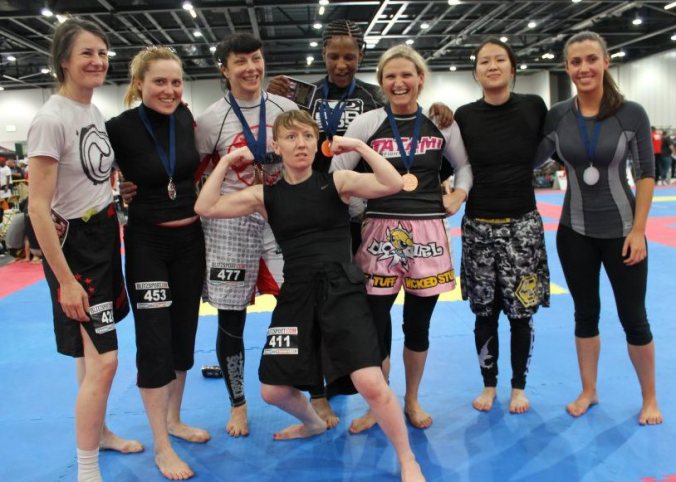
Me at the 2012 seni show (on the far right)

Finding Instruction

To get the best out of your yoga training, finding a yoga instructor with extensive BJJ experience is evidently a strong advantage. You can still reap the benefits of yoga training from a regular class, but a teacher with BJJ experience can tweak the practice to better suit jiu-jitsu fighters.

To find out more or to book your own yoga workshop tailored for BJJ practitioners, get in contact with Lydia by clicking the link here.
The Benefits Of Yoga For Office Workers

Written by Lydia Lacey

Yoga has become increasingly popular in the corporate world – and for good reasons too.  Proven to be beneficial for overall physical, mental and emotional well-being, yoga is the ideal practice for any professional in the corporate world looking to de-stress, be healthy and happy. With corporations such as Apple, Nike and Google, along with numerous companies in London incorporating yoga into the work week for their staff, it’s clear that yoga has something vital to offer to your everyday office worker.

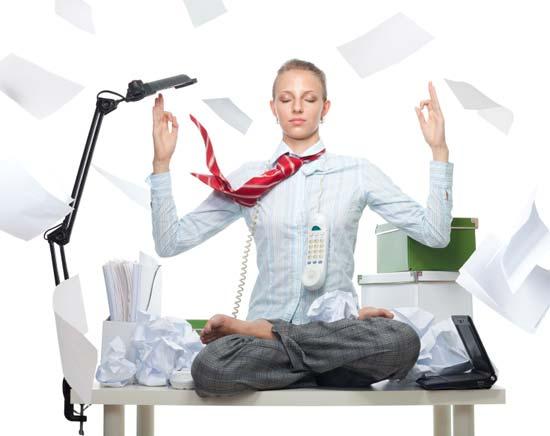
office-yoga

Sitting for long periods of the day has now been equated to smoking, in terms of the damage it has to your health. Inactivity in conjunction with stress from work can literally strip years off your life, unless necessary action is taken. Fortunately, practicing yoga can counteract the variety of negative health effects an office job can bring. This includes:

Poor posture & Immobility

Many workers that are hunched over their desk for the majority of the day experience some form of back or neck pain. Sitting hunched forward for long periods shortens the pectorals (chest muscles), whilst weakening the trapezius (muscle round the lower back of the neck). This is damaging to the spine, and serves to create a hunched over posture. In addition, the hip flexor muscles are also shorted, becoming restrictive and inflexible. Immobility in the hips is the leading cause for falls in the elderly, which is why it is important to retain physical flexibility as you age.

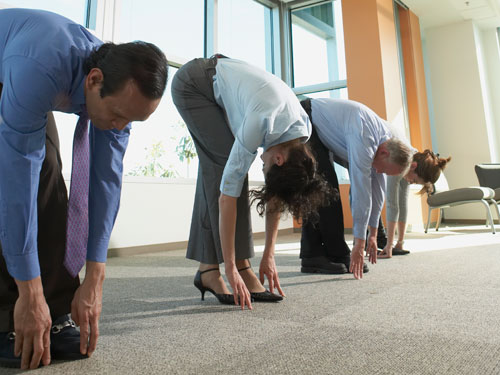
Yoga both stretches and strengthens your chest, back and hips, and is the ideal practice to counteract the negative effects being seated for most the day has on your body. By targeting these areas, yoga serves to not only improve posture, but resolve a great deal of back/neck pain too.

Stress & Unhappiness

Through simply stretching, your body releases dopamine – a chemical within the brain that increases feelings of happiness. As stress is naturally stored within the muscles of the body, stretching relaxes both the body and the mind, as they’re both intimately connected.

In addition, through yoga, you learn how to slow down and expand through the breath, which has a relaxing effect on the sympathetic nervous system, essentially switching your mind from fight/flight mode, to relaxation mode. This is a helpful technique, in moments of stress and/or anxiety in the workplace.

Weight Gain

Sitting for long periods of the day not only weakens your abdominals, but it also compresses the stomach too, which slows down digestion – typically leading to weight gain. Sitting for long periods of the day can also lead to bloating, cramping and constipation, which is a great source of discomfort for many.

Fortunately yoga not only engages and strengthens the abdominals, but also aids digestion too. Twisting postures tone and stretch the abdominals, serving to massage the internal organs and promote blood flow, which aids digestion and detoxifies the body.

Could Yoga Benefit You?

There are a series of yoga poses and stretches that can improve virtually any health problem created by office inactivity or stress. Whether it’s insomnia, poor circulation, immobility or back pain, there will be a yoga pose that can aid in overcoming the problem. As nothing is more important than your own health and happiness, it is important to look after your body the best way you can.

To find out more or to book a corporate class with Lydia, click the contact link here.

stretching-in-office-16052011


Dealing With Anxiety Through Meditation

Written by Lydia Lacey

I was about 17/18 years old when I first started practicing yoga, after experiencing a debilitating lower back injury through martial arts, my physiotherapist recommended I take up the practice. After a few sessions, the pain from my injury completely subsided and I was officially hooked to my yoga practice. Initially however, I never really paid attention to the breathing element of yoga and I had absolutely zero interest in meditation. Reflecting back on my younger narrow-minded self, I associated breathing techniques and meditation as something that only weed smoking hippies dressed in psychedelic patterns would practice – not something I considered cool back then!

It wasn’t till a couple years later that I was open to the idea of practicing meditation or breathing exercises. As a natural over-thinker prone to anxiety – incorporating meditation into my routine really was life changing. Better late than never!

The basis behind yogi breathing

The idea behind breathing techniques is that you can control your state of mind with the flow of your breath. The mind, body and breath are intimately connected, so our thoughts and physiology can be influenced via our breathing pattern (this has been scientifically proven too). If you think about people that suffer from stress or anxiety, you’ll notice that in their most anguished states, these people suffer from a short, sharp and erratic breathing pattern. So in times when your emotions get the best of you, pause and take a moment to acknowledge your breathing, and remind yourself that you can take back control over how you’re feeling by simply slowing down and expanding your breath. This can switch off the panic or stress response we have built in our minds, as slow breathing has a calming effect on our nervous system.

Think of it this way, your mind is either the key to happiness and bliss or the barrier to it. Your mind can be either productive or destructive. There is no source outside of you that is responsible for how you feel and respond to situations. Once you recognise this reality, you empower yourself to change your mind and your state of emotions.

yoga-breathing-6

How breathing influences your physiology

Slow, deep breathing can in moments of stress switch us from the sympathetic (fight or flight response), to the parasympathetic nervous system (relaxation response). In moments of intense panic, anxiety or stress, the sympathetic nervous system sends signals through the automated nerves to the adrenal glands, which produce adrenaline. Adrenaline causes the heart rate to increase and the breathing to become more rapid. This is exactly the opposite of what you want to achieve during bouts of anxiety and stress. By breathing rapidly, you are confirming to your body that you are in a state of stress, and your body will respond by releasing the hormones relative to your current state of being. It’s a destructive circle that can easily spiral downwards at the worse moments.

Fortunately however, we are not helpless to this process. By taking deep breaths, we can start to slow down and reverse this response in moments of anxiety by dampening our body’s production of stress hormones. By stimulating the parasympathetic nervous system, we bring ourselves into a relaxed state of being, both physically and mentally.

By voluntarily changing the rate, depth, and pattern of breathing, we can change the messages being sent from the body’s respiratory system to the brain. In this way, breathing techniques provide a portal to the autonomic communication network through which we can, by changing our breathing patterns, send specific messages to the brain using the language of the body, a language the brain understands and to which it responds. Messages from the respiratory system have rapid, powerful effects on major brain centers involved in thought, emotion, and behavior.

just-breathe

Taking control of your breath

So the breathing pattern I practice at home (and teach at my yoga classes) goes like this:
Inhale in through the nose and exhale out through the mouth. Once you get into this flow after a few breaths, start to invite your inhalations down a little bit deeper while simultaneously slowing down your breath.

Then when you’re ready, start to follow your exhalations all the way through to the end, so there is no more air to expel from the body. This will naturally create space within the lungs for a fuller breath of fresh air by ejecting any stagnant oxygen from within the body. Following this complete exhalation, take a deep inhalation once again in through the nostrils and this time; try to inhale slowly to your full lung capacity as you inhale past the chest, into the lower stomach. As you take these deeper breaths, think of it as you’re trying to fill all of that lung space by inhaling fully.

So now, continuing with this deep breathing pattern, start to slow your breathing rate down to 3-4 seconds for both your inhalations and for your exhalations. During this time frame, you are both inhaling fully on your inhalations and exhaling completely on your exhalations.

Generally, our breathing doesn’t tend to go past the chest area in our regular day to day breath, but when you breathe deeply and fully, your stomach, chest and collarbones will start to expand and rise as it fills with oxygen.

Final Thoughts

I never realised until I started practicing meditation, the ways in which overthinking and anxiety could restrict you in so many areas of life. From limiting my interaction in social settings to preventing me from making bold leaps in the right direction with my career, to simply causing me unnecessary worry. Anxiety at its worse steals your peace away from the present moment, often blocking suffers from progressing forward in many areas of their lives too.

Daily meditation makes you all the more reflective on where your own overthinking and negative thought patterns are really the only things that are holding you back. Deep breathing exercises in moments of anxiety, worry and/or panic can enable you to restore a sense of calamity into your state of mind and emotions, putting you in control over how you feel at any given time.